
From Trading Station II and DailyFX to the Swiss-franc shock, the U.S. exit and two separate 2026 deals
On 6 October, Trade Nation said it had agreed to take over FXCM's UK client book. Three days later, AvaTrade announced an agreement to acquire the majority of FXCM Group's business and its brand. Two buyers and two transactions invite a simple conclusion: has the broker founded in 1999 been sold off entirely? Not yet. The UK deal concerns the client book of Stratos Markets Limited, which operates as FXCM in Britain. In the wider transaction, Jefferies subsidiary Stratos Group International has agreed to sell substantially all of its assets and business operations. Neither announcement establishes that all customer transfers have closed, or that the FXCM name is about to disappear. [Trade Nation](https://tradenation.com/en-gb/articles/trade-nation-to-acquire-fxcm-uk-client-book/) · [Jefferies filing](https://www.sec.gov/Archives/edgar/data/96223/000009622326000033/jef-20260831.htm) · [AvaTrade](https://www.businesswire.com/news/home/20261009722541/en/)
The more revealing question is how a broker that once built a competitive system around trading software, market research and an international client network reached a point where its UK customer relationships and most of its other operations are set to pass to different owners. What, precisely, might survive of FXCM's name, technology and customer relationships?
An online-FX pioneer reaches the stock market
FXCM was founded in 1999, during the first wave of retail access to online foreign-exchange trading. Its ambition was broader than moving telephone dealing onto a website: it assembled pricing connections, execution, account infrastructure, trading tools and content distribution into a business that could expand across markets. In its 2010 IPO prospectus, the company said its platform connected with multiple banks and market makers and served roughly 175,000 retail and institutional clients worldwide. FXCM listed on the New York Stock Exchange that year. Those figures describe its disclosures at the time, not its size today. [FXCM IPO prospectus](https://www.sec.gov/Archives/edgar/data/1499912/000095012310110764/y87330b4e424b4.htm)
Two assets gave that system its character. Trading Station II, often shortened by traders to TS2, was FXCM's proprietary desktop terminal, not a reskinned MetaTrader. Traders used it for charts, prices and order entry. Behind that interface sat FXCM's own pricing, execution and back-office technology, with scope for automated strategies and outside connections. The 2010 prospectus reported more than 215,000 trades a day through TS2 and cited FX Week retail-platform awards for 2009 and 2010. These are historical company disclosures and awards, not evidence of present-day volume or ranking. FXCM still advertises Trading Station in desktop, web and mobile forms, although features vary by version and jurisdiction. [2010 prospectus](https://www.sec.gov/Archives/edgar/data/1499912/000095012310110764/y87330b4e424b4.htm) · [Current platform page](https://www.fxcm.com/ca/platforms/trading-station/)
For a genuine view of the period interface, see page 14 of [FXCM's 2010 annual report](https://www.annualreports.com/HostedData/AnnualReportArchive/f/NYSE_FXCM_2010.pdf). It should not be mistaken for a current software screenshot.
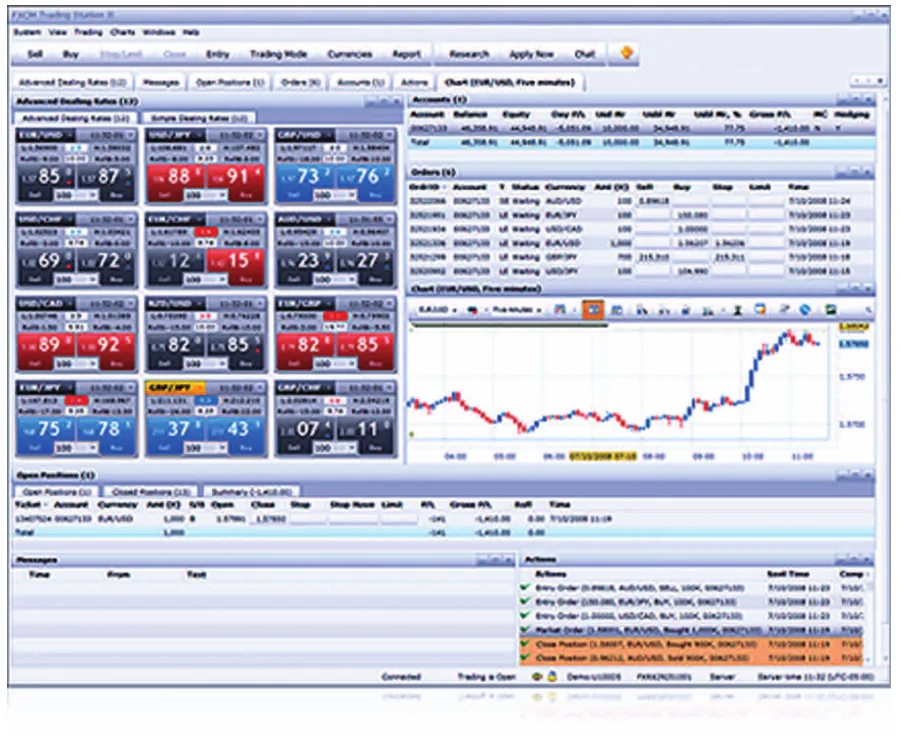
Image: Trading Station II in FXCM's 2010 annual report, printed p. 14; not the current interface.
DailyFX was the other half of the franchise: news, analysis and education as a route into the trading platform. FXCM launched it in 2003. Its 2010 prospectus said nine full-time analysts produced more than 30 pieces a day; the site drew over 500,000 unique monthly visitors and six million monthly page views, and more than 80 websites republished its work. After search advertising, DailyFX was then its largest single source of new-customer leads. All those audience numbers are historical self-reports, not 2026 traffic. The lasting point is the business model: research attracted readers; the platform could convert them into customers; client activity, in turn, informed market coverage. DailyFX showed early that serious content could be integral to an online brokerage rather than a decorative blog. [2010 prospectus](https://www.sec.gov/Archives/edgar/data/1499912/000095012310110764/y87330b4e424b4.htm)
A [1 January 2010 archived DailyFX homepage](https://web.archive.org/web/20100101081626/http://www.dailyfx.com/) shows the period's presentation, though some archived widgets are incomplete. Page 12 of [FXCM's 2010 annual report](https://www.annualreports.com/HostedData/AnnualReportArchive/f/NYSE_FXCM_2010.pdf) preserves the company's contemporary description of the service.
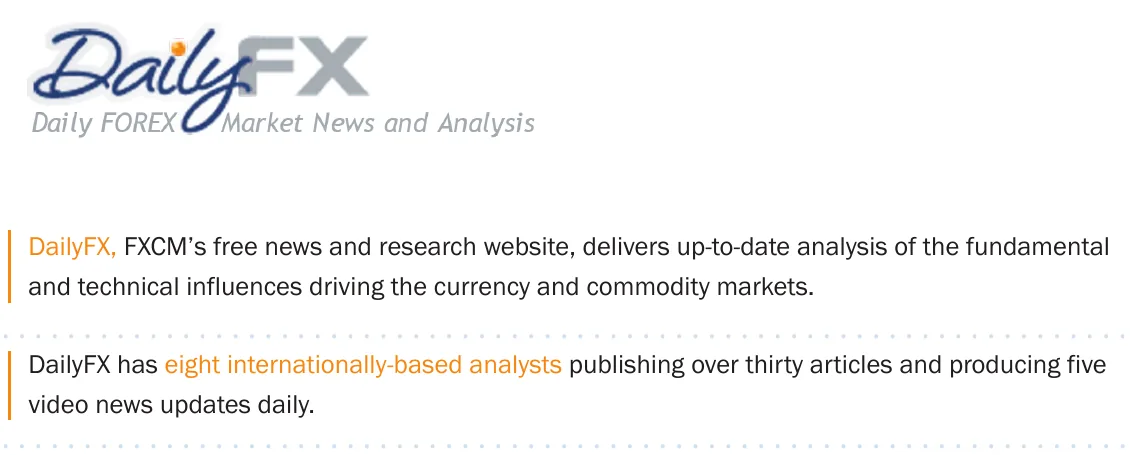
Image: FXCM's 2010 annual report, printed p. 12, not a DailyFX website screenshot. This page says “eight analysts”; the contemporaneous prospectus cited above says nine full-time analysts. The differing counts do not establish a staffing change.
The Swiss-franc shock changed the capital structure
On 15 January 2015, the Swiss National Bank abandoned its minimum EUR/CHF exchange rate. FXCM later reported approximately $275.1 million in client debit balances resulting from the violent move, temporarily breaching regulatory capital requirements. The following day Leucadia provided a $300 million term loan that allowed operations to continue. This was more than a bad directional call: negative client balances, evaporating liquidity and the broker's hedging relationship with liquidity providers transmitted a market dislocation onto the broker's own balance sheet. FXCM subsequently sold non-core businesses, including operations in Japan and Hong Kong, to reduce debt. [FXCM 2015 Form 10-K](https://www.sec.gov/Archives/edgar/data/1499912/000149991216000015/fxcm-20151231x10k.htm)
The [SNB's original 15 January release](https://www.snb.ch/en/publications/communication/press-releases/2015/pre_20150115) establishes the policy decision; it is not a statement of FXCM's losses. The latter must be checked against the broker's later filing.
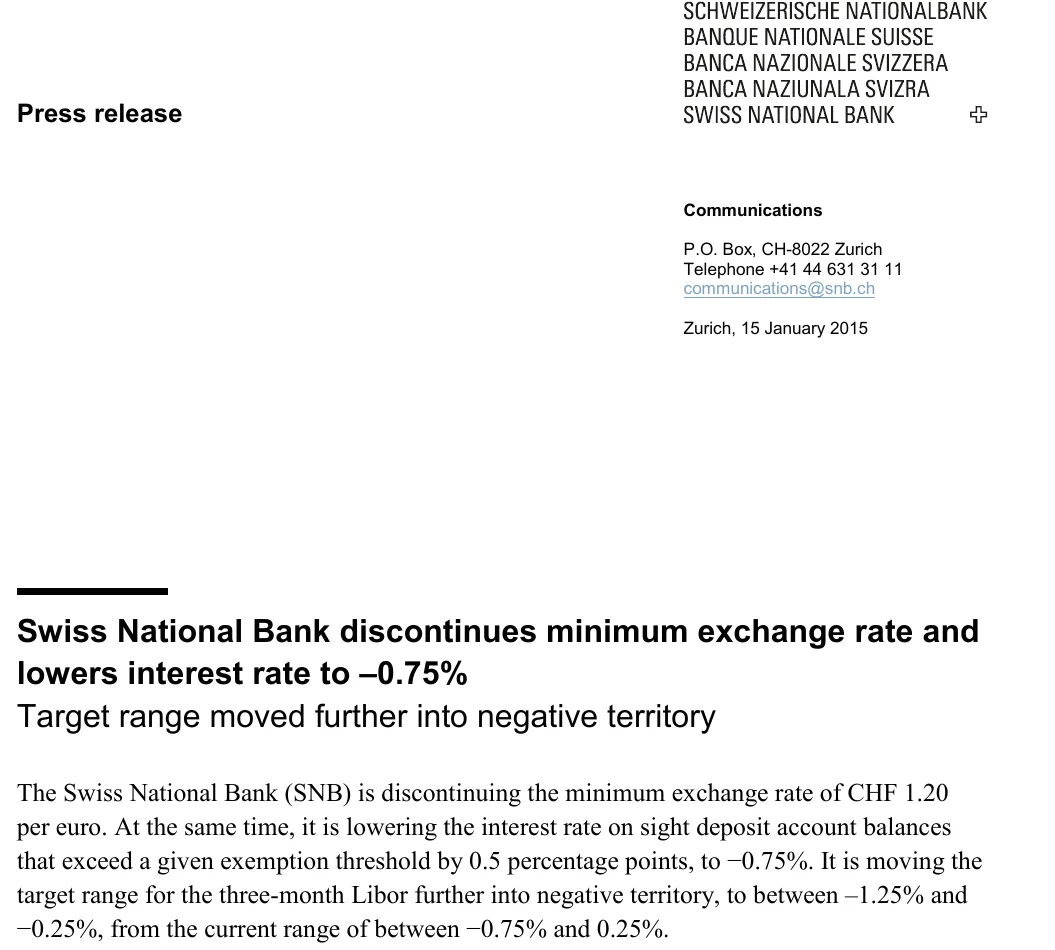
Image: Swiss National Bank release of 15 January 2015. It documents the policy decision, not FXCM's later reported client debit balances.
DailyFX was sold to IG Group for $40 million in October 2016. In the context of asset disposals, it was both an asset that could be monetised quickly and one with durable value. IG called it a research and education portal and said it expected to use it to attract and retain clients. The sale does not show DailyFX had failed; it shows the content operation had value independent of its original owner. It has not been an FXCM-owned asset since then. [IG Group 2017 annual report](https://www.iggroup.com/~/media/Files/I/IG-Group/documents/investors/financial-results/results-reports-and-presentations/ar-2017.pdf)
A separate breach of trust: leaving the United States
FXCM also faced a reputational break that refinancing could not repair. In February 2017, the U.S. Commodity Futures Trading Commission issued a settlement order finding that FXCM's U.S. entities had made misleading representations about their “No Dealing Desk” model and their relationship with a principal market maker from 2009 to at least 2014. The order imposed a combined $7 million civil penalty on the named parties and required withdrawal of their U.S. registrations. FXCM's contemporary statement said the named firms and individuals neither admitted nor denied the allegations in settling. Both distinctions matter: the regulator's formal findings should not be softened, but misconduct by the U.S. entities in that period should not automatically be attributed to every later overseas entity or product. [CFTC release](https://www.cftc.gov/PressRoom/PressReleases/7528-17) · [FXCM statement](https://www.sec.gov/Archives/edgar/data/1499912/000114420417006309/v458550_ex99-1.htm)
FXCM then left the U.S. retail-FX market. GAIN Capital reported that it completed the transfer of FXCM's U.S. client book on 24 February 2017, with more than $140 million in customer assets moving to FOREX.com. A further distinction is frequently lost: the company that later entered a U.S. Chapter 11 proceeding was the listed holding company Global Brokerage, not the continuing FXCM Group. Global Brokerage said explicitly that FXCM Group was not a debtor in that filing. Conflating them distorts the following decade of the broker's history. [GAIN Capital](https://www.sec.gov/Archives/edgar/data/1444363/000144436317000052/ex9913-31x17earningsrelease.htm) · [Global Brokerage](https://www.globenewswire.com/news-release/2017/12/12/1251138/33730/en/Global-Brokerage-Inc-Receives-Approximately-78-5-Yes-Votes-to-Move-Forward-with-the-Prepackaged-Plan-of-Reorganization.html)
The rescuer becomes the owner, then agrees to sell
Leucadia subsequently became Jefferies Financial Group. Jefferies' annual report says it previously held 49.9% of Stratos voting interests and, in September 2023, foreclosed on the remaining 50.1% pledged by Global Brokerage as loan collateral. Stratos thereby became wholly owned. A lending and collateral relationship had become control, but this does not imply a customer-asset shortfall in 2026. In its 2026 quarterly filing, Jefferies discussed the Stratos sale in the context of reducing older non-core investments. The documents support the conclusion that Jefferies intends to exit this holding; they do not establish that FXCM is now insolvent or that a single undisclosed loss caused the sale. [Jefferies 2023 Form 10-K](https://www.sec.gov/Archives/edgar/data/96223/000009622324000006/jef-20231130.htm) · [2026 Form 10-Q](https://www.sec.gov/Archives/edgar/data/96223/000009622326000033/jef-20260831.htm)
The two new agreements have different perimeters. Trade Nation intends to acquire the UK client book of FCA-authorised Stratos Markets Limited (FRN 217689), with transfer expected in late November 2026. It is not buying the whole FXCM Group, and the announcement did not itself move contracts, positions or cash. FXCM's UK notices now say that, on a customer's transfer date, the old account and open positions will close; Trade Nation will open a new account and receive personal details and funds. Positions still open at the relevant deadline will not move intact. Affected clients need to check their own formal notice for dates, opt-out options and settlement, rather than assume a seamless copy of their account. [Trade Nation timetable](https://tradenation.com/en-gb/fxcm/) · [FXCM account FAQ](https://www.fxcm.com/uk/help/what-is-happening-to-my-fxcm-account/) · [FXCM positions FAQ](https://www.fxcm.com/uk/help/what-happens-if-i-do-nothing-at-all/)
AvaTrade says it has agreed to acquire the majority of FXCM Group's business and its brand. Jefferies' legal disclosure says subsidiary Stratos Group International signed a definitive agreement with AvaTrade Markets Ltd. to sell substantially all assets and business operations, with the assets expected to migrate over about 120 days. Public documents do not yet identify every licensed entity in the perimeter, the ultimate scope of FXCM Pro or other institutional business, jurisdiction-specific approvals, the future of each platform or the consideration. The 120 days are an expected migration window, not a single completion date for all customers. [Jefferies filing](https://www.sec.gov/Archives/edgar/data/96223/000009622326000033/jef-20260831.htm) · [AvaTrade release](https://www.businesswire.com/news/home/20261009722541/en/)
In what sense could FXCM disappear?
If the agreements close on their announced terms, FXCM's relatively independent, multi-jurisdiction brokerage structure under Jefferies will fundamentally change, and its UK customer relationships will move elsewhere. A changed operating structure is not the same as a vanished brand. AvaTrade expressly includes the FXCM name in the proposed acquisition, leaving open the possibility of continued use. Whether it remains a separate public-facing brand, in which countries and for how long cannot yet be verified.
Trading Station II's historical significance will not vanish with a change of owner. Whether an acquirer retains its technology, interfaces and familiar trading workflow is a separate, unanswered operational question. DailyFX left FXCM in 2016: it is part of the broker's legacy, not a present asset awaiting transfer. For clients, the practical issues are less about four letters on a website than about the contracting firm, licence holder, custody and payment path, open positions, platform availability, charges and complaint routes.
TraderVote's assessment is that the form most likely to disappear is not necessarily the FXCM name or its technical influence. It is the once-integrated franchise that combined proprietary software, a research publisher, global client relationships and independent control. That is an editorial inference from the disclosed transaction structures—not a prediction that the deals have closed, the brand will end or any particular client's account has moved. The next facts to check are closing announcements and jurisdiction-by-jurisdiction customer notices. “Signed” must not be rewritten as “migrated.”
Principal sources
- [FXCM 2010 IPO prospectus](https://www.sec.gov/Archives/edgar/data/1499912/000095012310110764/y87330b4e424b4.htm), 3 December 2010; [current Trading Station page](https://www.fxcm.com/ca/platforms/trading-station/), undated.
- [FXCM 2015 Form 10-K](https://www.sec.gov/Archives/edgar/data/1499912/000149991216000015/fxcm-20151231x10k.htm), 11 March 2016; [IG Group 2017 annual report](https://www.iggroup.com/~/media/Files/I/IG-Group/documents/investors/financial-results/results-reports-and-presentations/ar-2017.pdf).
- [CFTC release 7528-17](https://www.cftc.gov/PressRoom/PressReleases/7528-17), 6 February 2017; [Jefferies 2023 Form 10-K](https://www.sec.gov/Archives/edgar/data/96223/000009622324000006/jef-20231130.htm), 26 January 2024.
- [Trade Nation UK-client-book announcement](https://tradenation.com/en-gb/articles/trade-nation-to-acquire-fxcm-uk-client-book/), 6 October 2026; [Jefferies 2026 Form 10-Q](https://www.sec.gov/Archives/edgar/data/96223/000009622326000033/jef-20260831.htm) and [AvaTrade release](https://www.businesswire.com/news/home/20261009722541/en/), both 9 October 2026.
Sources accessed 16 October 2026 (America/Los_Angeles). This article is not investment advice.
Discussion
Comments (0)
Sign in to join the discussion.
Sign inNo published comments yet. Start the discussion.