

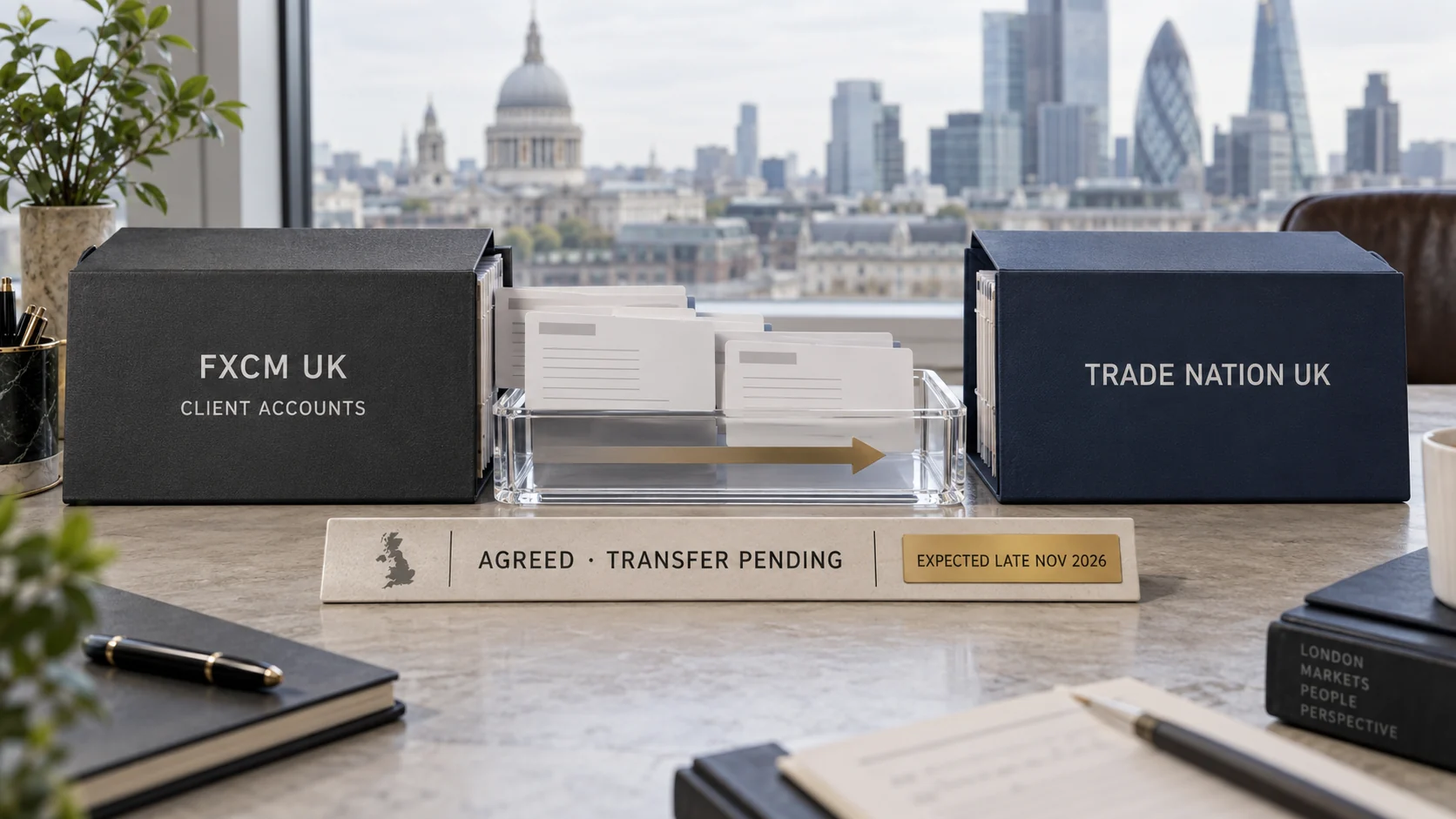
Trade Nation said on 6 October 2026 that it had agreed to acquire the UK client book of Stratos Markets Limited, operator of the FXCM and Tradu brands in Britain. The transfer is expected in late November; the price, client count and asset value were not disclosed.
Viewed alone, this is a transfer of UK retail trading accounts. Viewed against FXCM’s past decade, it is another milestone in a long contraction. The boundary still matters: Trade Nation is buying a UK client book, not the entire FXCM group, and the client transfer has not yet been completed.
Who is Trade Nation?
Trade Nation is a retail FX, CFD and financial spread-betting broker. Its receiving entity, Trade Nation Financial UK Ltd, is an English company numbered 07073413 and was previously called Finsa Europe Ltd. The legal entity was incorporated in 2009; the brand says it has served traders since 2014. It is authorised by the FCA under FRN 525164.
It does not have FXCM’s historical scale, but it has the infrastructure required for this transaction: the same UK regulatory perimeter, overlapping products and established systems for onboarding, segregated client money, execution, complaints and regulatory reporting. It is not building a broker from scratch; it is proposing to migrate eligible relationships into an existing operation.
Why can it buy the clients without “buying FXCM”?
A whole-company acquisition can bring cross-border entities, licences, staff, technology, historic liabilities and litigation. A client-book transaction is narrower: the buyer takes on eligible customer relationships and future servicing, subject to notices, contracts, customer choices and regulatory requirements.
Both UK entities are FCA-regulated and their retail product sets overlap. FXCM says affected accounts are due to move to Trade Nation Financial UK Ltd and that client money will remain segregated under FCA rules. After migration, Trade Nation’s terms, execution policy, risk disclosures and privacy policy will apply.
The answer to “how can Trade Nation afford it?” is therefore partly structural. It is not purchasing FXCM’s global business; it is acquiring a defined book that can be integrated into an existing platform. With no disclosed consideration, outsiders cannot verify what it paid.
Why does FXCM look as if it is continually being sold down?
The impression has a factual basis, but the story is not a single collapse. It is a sequence of capital shock, regulatory damage and changes of control.
2015: the Swiss-franc shock changed the capital structure
After the Swiss National Bank removed the EUR/CHF floor in January 2015, FXCM clients generated about $275.1 million in negative balances. FXCM temporarily breached certain regulatory-capital requirements and secured a $300 million term loan from Leucadia to keep operating. It subsequently sold non-core assets, including its Japanese and Hong Kong businesses, to repay debt. Strategy shifted from expansion to capital preservation and disposals.
2017: exit from US retail forex
In a final order, the CFTC found that FXCM made false and misleading “No Dealing Desk” representations and concealed its relationship with its principal market maker. The respondents paid a $7 million penalty; FXCM and two founders agreed to withdraw from CFTC registration and never seek registration again. The resulting US retail exit removed a core market and damaged the franchise.
2023: creditor control became full ownership
Jefferies disclosed that noteholders filed an involuntary bankruptcy petition against Global Brokerage and its holding company in March 2023. In September, Jefferies foreclosed on the pledged Stratos equity, moving from a 49.9% voting interest to 100% ownership and consolidating Stratos. This was not a conventional growth acquisition; a credit-and-collateral structure had become full control.
2026: operating pressure remains visible
For the quarter ended February 2026, Jefferies said Stratos performed below the prior-year period. It also said the reporting unit’s $5.5 million of allocated goodwill was highly sensitive to forecast assumptions and could be impaired if volumes or performance fell short. That does not establish insolvency or liquidation, but it is a public sign of pressure.
The UK client-book sale therefore fits a decade-long direction of narrowing scope, disposing of assets and restructuring ownership. “Long-term strategic contraction” is supportable; “FXCM has been sold out” is not.
Is there almost nothing left to sell?
The available evidence does not justify that conclusion. Stratos Markets Limited remains an active UK company, and Jefferies still reports Stratos as a consolidated subsidiary. This announcement covers the UK client book only; it does not say that other entities, licences, technology or the FXCM brand are being sold.
The precise conclusion is that FXCM’s footprint is materially smaller than at its peak and this is another carve-out. Whether Jefferies is preparing a wider exit requires further corporate or regulatory disclosure.
What clients should watch
Affected customers should identify their contractual entity, download transaction history and review changes to platform, spreads and fees, products, API or automated-strategy compatibility, funding, data handling and complaints. Account continuity does not mean identical trading conditions. Migration-themed phishing is also a risk, so notices should be checked only through official channels.
TraderVote view
The deal tells two opposing industry stories. Trade Nation is using an existing FCA platform to add scale through a client-book acquisition. FXCM is further dismantling the footprint of a once-global retail-FX franchise.
Trade Nation still has to retain the clients and execute a compliant migration. Jefferies and FXCM, meanwhile, have not disclosed whether other regional books or assets will follow. Until they do, a local optimisation and the prelude to a broader exit must remain separate possibilities.
Sources
Trade Nation announcement: https://www.prnewswire.co.uk/news-releases/trade-nation-to-acquire-the-uk-client-book-of-fxcm-stratos-markets-limited-302899767.html
FXCM UK transition guidance: https://www.fxcm.com/uk/help/c/accounts/trade-nation/
Trade Nation profile and Companies House record: https://tradenation.com/en-gb/about-us/; https://find-and-update.company-information.service.gov.uk/company/07073413
FXCM 2015 Form 10-K and CFTC 2017 final order: https://www.sec.gov/Archives/edgar/data/1499912/000149991216000015/fxcm-20151231x10k.htm; https://www.cftc.gov/PressRoom/PressReleases/7528-17
Jefferies 2023 control disclosure and 2026 quarterly report: https://www.sec.gov/Archives/edgar/data/96223/000009622324000024/R15.htm; https://www.sec.gov/Archives/edgar/data/96223/000009622326000017/jef-20260228.htm
Written independently by Hengyuan from public information verified through 6 October 2026. This is not investment, legal or account-transfer advice. CFDs and other leveraged products can cause rapid losses.
Discussion
Comments (0)
Sign in to join the discussion.
Sign inNo published comments yet. Start the discussion.