

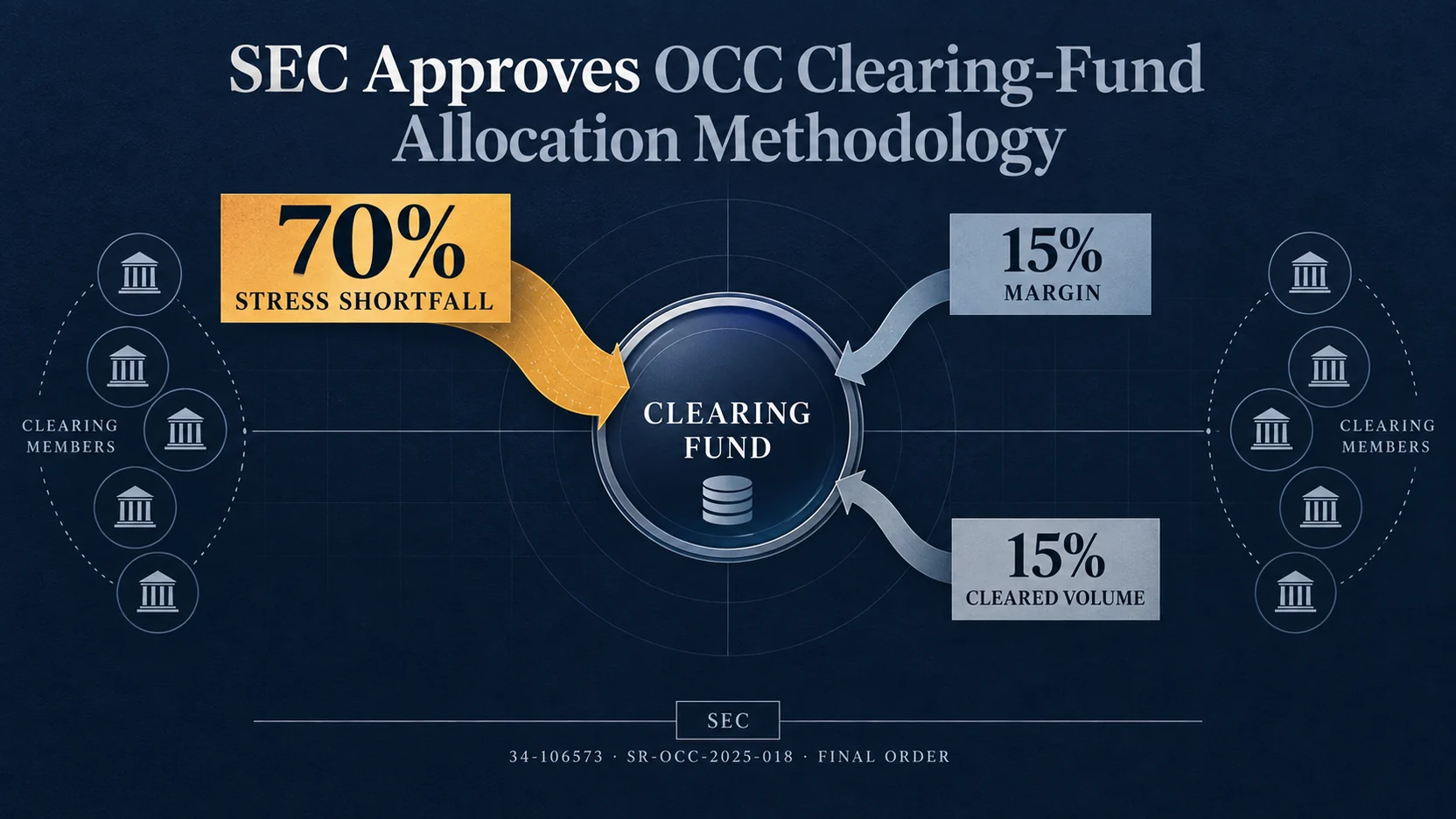
The SEC issued order 34-106573 on 2 October, setting aside an earlier delegated decision and approving OCC’s new method for allocating Clearing Fund deposits among members. The file is SR-OCC-2025-018.
OCC is the sole clearing agency for US exchange-listed options and a systemically important financial market utility. The change does not resize the fund itself. It changes how the required pool is divided among clearing members.
A 70/15/15 formula centred on tail risk
The existing allocation is 70% margin, 15% open interest and 15% cleared volume. The approved formula becomes 70% shortfall, 15% margin and 15% volume, eliminating open interest. “Shortfall” means estimated stress losses above a member’s margin under the scenarios used to size the fund.
The lookback extends from one month to three months. OCC may also hold monthly weights constant during volatile periods when justified by current facts, financial stability and legitimate member interests.
Why the first approval was stayed
SEC staff approved the proposal under delegated authority in December 2025. Fidelity petitioned for review, automatically staying that order. Robinhood, Charles Schwab, LPL and others raised concerns that agency brokers serving retail clients could bear disproportionate costs while some proprietary firms or market makers paid less.
OCC argued that higher contributions would reflect tail risk that had previously been underpriced. FIA supported closer alignment with stress exposure while noting concerns about the sharp fall in the margin weight and possible overlap with stress-based margin add-ons.
The Commission’s final decision
After a de novo review of the full record, the Commission found the proposal consistent with Exchange Act requirements governing resources, risk management, fair treatment and competition. It concluded that members creating more losses beyond margin may appropriately provide more resources before risk is mutualised.
The order does not disclose member-by-member effects or a launch date. OCC said impact data could be provided to members and that parallel daily projections would be available through ENCORE before implementation.
Impact and TraderVote view
Traders will not receive direct clearing-fund charges, but higher funding and liquidity needs at clearing brokers can influence risk limits, product access and operating costs. Members must prepare for more stress-sensitive funding demands and monitor how the hold-constant authority is governed.
The reform makes the price of tail risk more explicit. That can reduce cross-subsidies, but model design determines which business models pay more. Regulatory approval confirms legal consistency; it does not eliminate model risk, liquidity pressure or implementation disputes.
Sources
SEC final order 34-106573: https://www.sec.gov/files/rules/sro/occ/2026/34-106573.pdf
OCC member memorandum: https://www.sec.gov/files/rules/sro/occ/2025/34-104359-ex2.pdf
OCC response to the petition: https://www.sec.gov/comments/sr-occ-2025-018/srocc2025018-695847-2175634.pdf
FIA industry response: https://www.fia.org/fia/articles/fia-responds-occs-clearing-fund-allocation-proposal
Written independently by Hengyuan from public information verifiable as of 5 October 2026. This article is not investment or legal advice.
Discussion
Comments (0)
Sign in to join the discussion.
Sign inNo published comments yet. Start the discussion.