
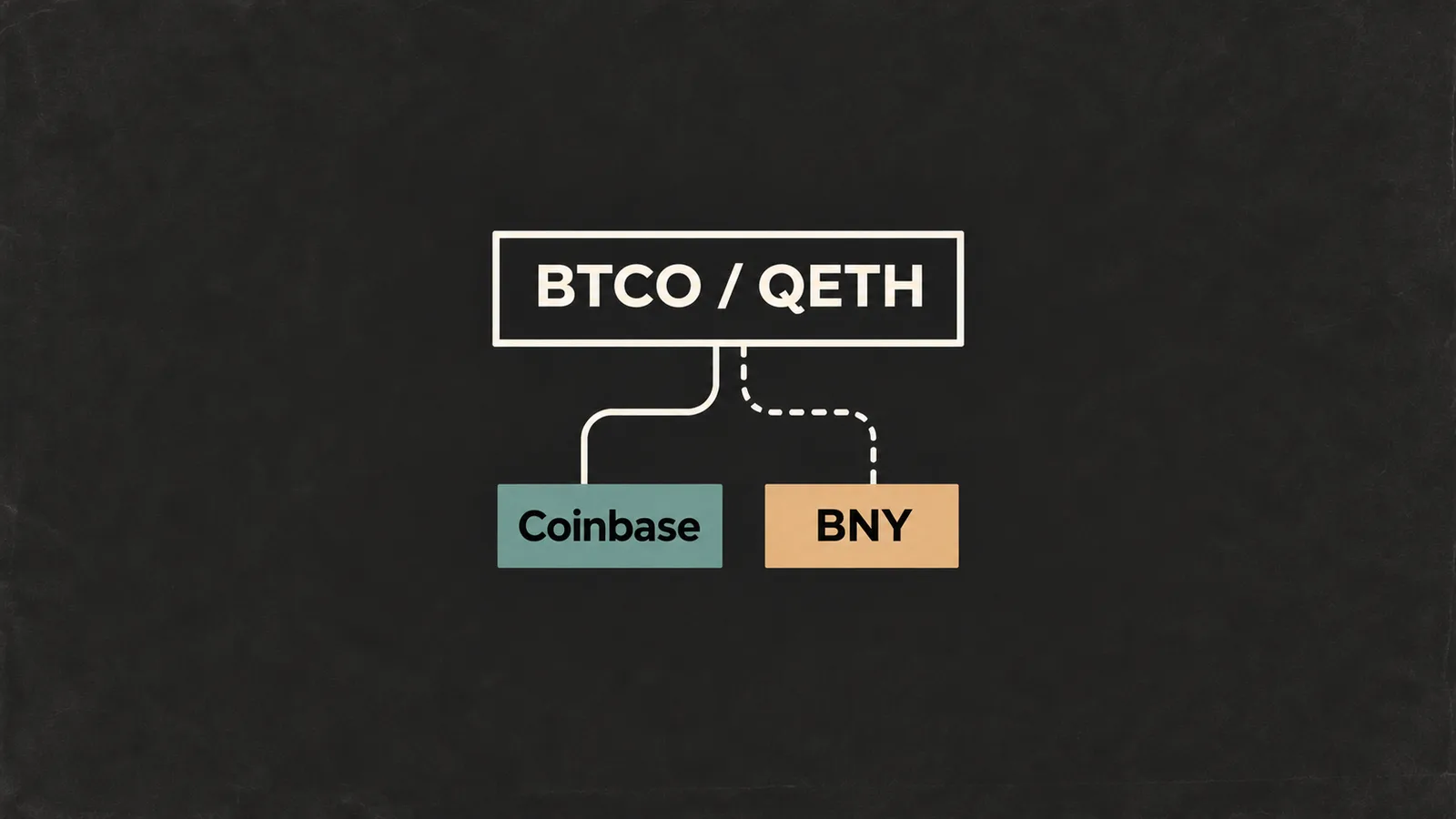
Two new custody contracts sound like a second line of defense for a fund. The filings do not yet tell investors how much, if any, of the assets will sit behind that second line.
Invesco Galaxy Bitcoin ETF (BTCO) and Ethereum ETF (QETH) each disclosed a digital-asset custody agreement dated 6 November with The Bank of New York Mellon (BNY), a New York-organized bank. BNY is to establish segregated accounts on its books for the funds' bitcoin or ether. Sponsor Invesco Capital Management anticipates using both BNY and Coinbase Custody Trust Company. The existing Coinbase arrangements remain in force. This is not a replacement of Coinbase, an acquisition of either fund, or a transfer of the entire portfolio.
An existing partner takes on a new role
The funds' September 30 quarterly reports said Coinbase Custody Trust Company then held all of BTCO's bitcoin and QETH's ether. BNY was already the administrator, transfer agent and cash custodian. The change is an expansion into digital-asset custody, not an unknown institution suddenly taking control of the funds. Each new contract has an initial five-year term, calls for segregated accounts and requires BNY to maintain commercially reasonable insurance. The disclosed wording does not state a coverage amount or promise that every possible loss will be paid in full.
A second name is not half the risk
A second custodian could reduce dependence on a single provider. But actual diversification turns on where assets are placed, whether authorization and key controls are independent, and whether the fund can keep creations and redemptions running if one provider fails. The filings establish signed agreements and an intention to use both providers. They do not quantify a transfer, an allocation ratio or a tested failover. Calling this completed diversification would answer questions the issuer has not answered.
Nor does a second custodian remove risks shared through the sponsor's instructions, the creation-and-redemption chain or the underlying blockchains. That is TraderVote's analysis, not an allegation about either custodian's security. Custody diversification can split some single-point exposure; it cannot replace transaction approval, anomaly detection, reconciliation or a workable loss-response plan.
What investors should ask next
BTCO and QETH holders own fund shares, not personal wallets at BNY or Coinbase. The BNY agreement says it may be enforced only by its parties; a shareholder gains no direct contractual right under that agreement merely by owning the ETF. Any separate statutory rights are another question. The next useful disclosure is not a longer list of custodians but the actual allocation, the independence of controls, insurance and liability limits, and how redemptions would function in an incident.
A longer custodian list is a possible step forward, not proof of safety. The test of this agreement will be whether subsequent holdings and operational disclosures show where the risk has actually gone.
Sources: BTCO and QETH Form 8-K reports and attached BNY custody agreements (event date 6 November 2026); the funds' Form 10-Q reports for the quarter ended 30 September 2026. All SEC filings accessed 13 November 2026, Los Angeles time. Cover is a conceptual graphic, not an account map or facility photograph.
This article is not investment advice.
Discussion
Comments (0)
Sign in to join the discussion.
Sign inNo published comments yet. Start the discussion.