
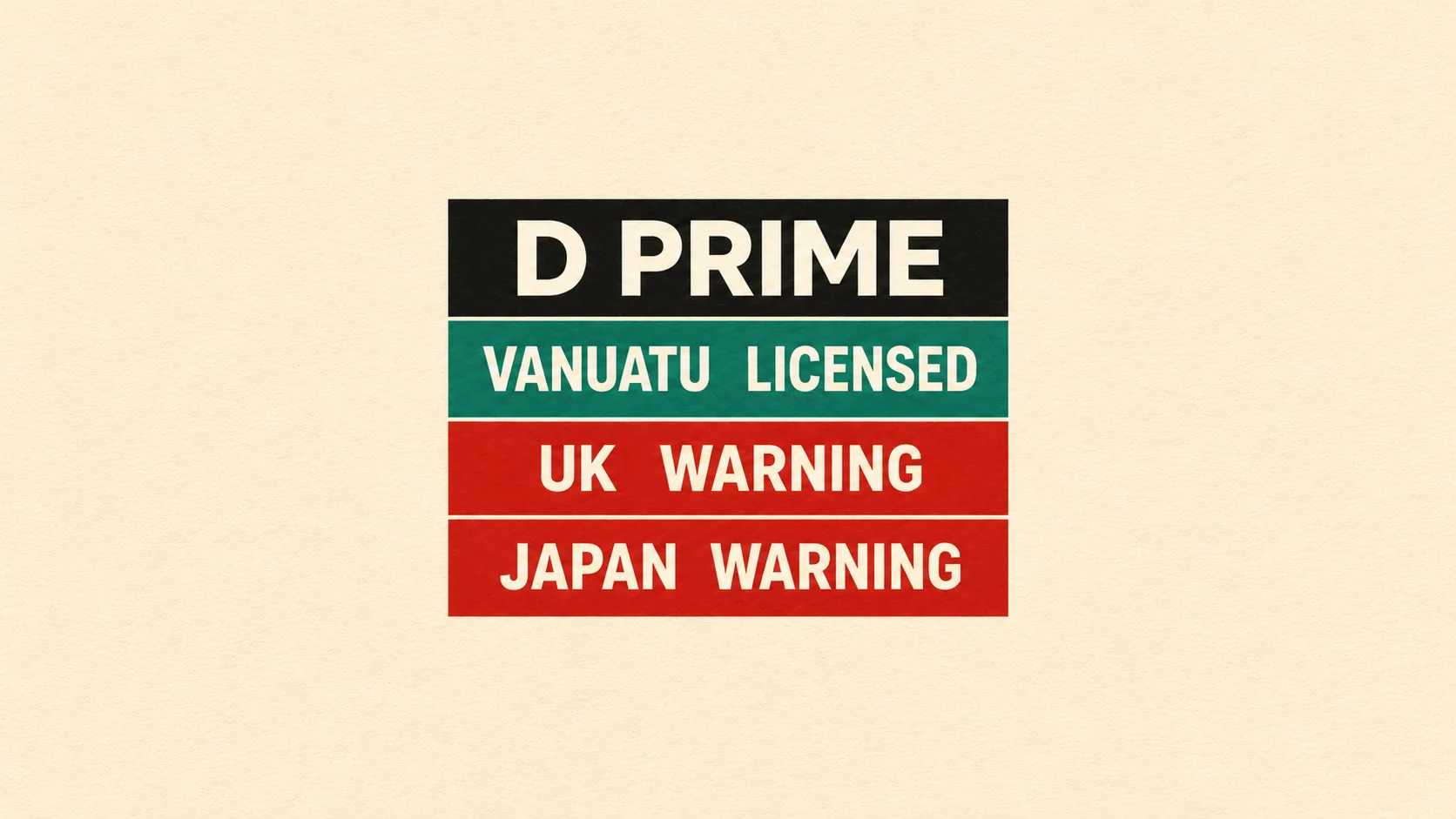
On 13 November the UK Financial Conduct Authority (FCA) warned about D Prime Vanuatu Limited, saying the firm may be providing or promoting financial services without UK permission and naming dooprime.com among its websites. Japan's Kanto Regional Finance Bureau had warned about the same named entity on 25 September, describing online solicitation of over-the-counter derivatives. These are separate jurisdictional warnings, not a joint investigation, a fraud conviction or evidence that customers have lost money.
The point is larger than another broker appearing on a warning list. A licence in one place is not permission to solicit clients everywhere else. Nor does a website disclaimer, by itself, settle what actually happened in advertising, onboarding or payments.
Name the legal entity before claiming a licence
D Prime is a forex and CFD brand listed by TraderVote. A brand is not a single licensed company. Its published Client Agreement defines the contracting 'Company' as D Prime Vanuatu Limited. The Vanuatu Financial Services Commission's live financial-dealer list shows that entity as number 700238, classes A/B/C, with 'Active' status. The FCA warning therefore does not mean the Vanuatu licence is absent, or that every entity using the brand lacks authorisation. It concerns this particular entity's UK perimeter.
Japan's bureau says the named entity solicited OTC derivatives online, and notes that dealing with Japanese residents generally requires local registration. It cautions that names and addresses in its notice come from solicitation materials and may be inaccurate. Neither regulator's public text establishes that the UK and Japanese warnings concern the same customers or money flows.
A prohibited-country footnote is not the end of the inquiry
D Prime's website says it does not offer services in the UK and describes the site as a central information platform, not a targeted offer to any jurisdiction. That company statement matters. But the FCA nevertheless named dooprime.com and said D Prime Vanuatu Limited may be operating or promoting without UK permission. The public notice does not show the underlying ad, account application or customer contact, so we cannot fill those gaps with invented accusations. Equally, the company's footnote is not independent proof that no UK-facing activity occurred.
The useful test runs along the transaction: whom did an advertisement or agent actually reach; who could open an account; which legal entity appears on the signed agreement; whose name receives the deposit; where can a dispute be pursued? The brand, site, contractual counterparty and payment facilitator need not have the same name. 'Regulated in multiple places' is no substitute for those answers.
Client money follows contracts and counterparties, not a marketing map
The company's Risk Disclosure says client assets are held on trust and apart from its own bank account. It also says customer funds may be pooled in an omnibus account and passed to banks, brokers or other third parties outside Vanuatu for trades or collateral. In a third party's insolvency, recovery may fall short and the company may have only an unsecured claim on clients' behalf. These are disclosed contractual risk scenarios, not proof of a current loss, shortfall or inability to pay.
The site also says Doo Solutions Cyprus Ltd facilitates some administrative and payment-related functions for D Prime Vanuatu Limited, but does not itself provide Cyprus- or EU-regulated financial, investment or payment services. Processing a payment and owing the trading obligation are different roles. A client should identify the actual contracting company, deposit-account name, custody arrangements and complaint route for their own account, not assume a payment-page country grants that country's protection.
The FCA says UK clients dealing with the warned firm would not have access to the Financial Ombudsman Service or Financial Services Compensation Scheme. That is not a blanket statement about every D Prime customer worldwide. It is, however, a concrete warning that 'global' reach can leave a client far from an enforceable local remedy.
TraderVote's view: the industry's blind spot is not whether a broker has any licence. It is treating one licence as a portable guarantee. The UK and Japanese warnings are not final liability findings; we will neither convict the firm for the regulators nor let a disclaimer close the case for it. A broker that wants to demonstrate cross-border compliance should make five answers easy to verify: who solicits, who signs, who receives the money, who holds it next, and who is accountable when it goes wrong. Without that chain, a glossy regulatory map is only marketing.
Sources: FCA, 'D Prime Vanuatu Limited' (13 November 2026); Kanto Regional Finance Bureau warning on D Prime Vanuatu Limited (25 September 2026); VFSC Financial Dealers Licensee List (accessed 17 November 2026); D Prime Client Agreement (updated 25 February 2026), Risk Disclosure (updated 5 August 2026), and legal-documents/jurisdiction notice (accessed 17 November 2026, Los Angeles time). The cover is a conceptual editorial graphic, not a regulator document or real map.
This article is not investment advice.
Discussion
Comments (0)
Sign in to join the discussion.
Sign inNo published comments yet. Start the discussion.